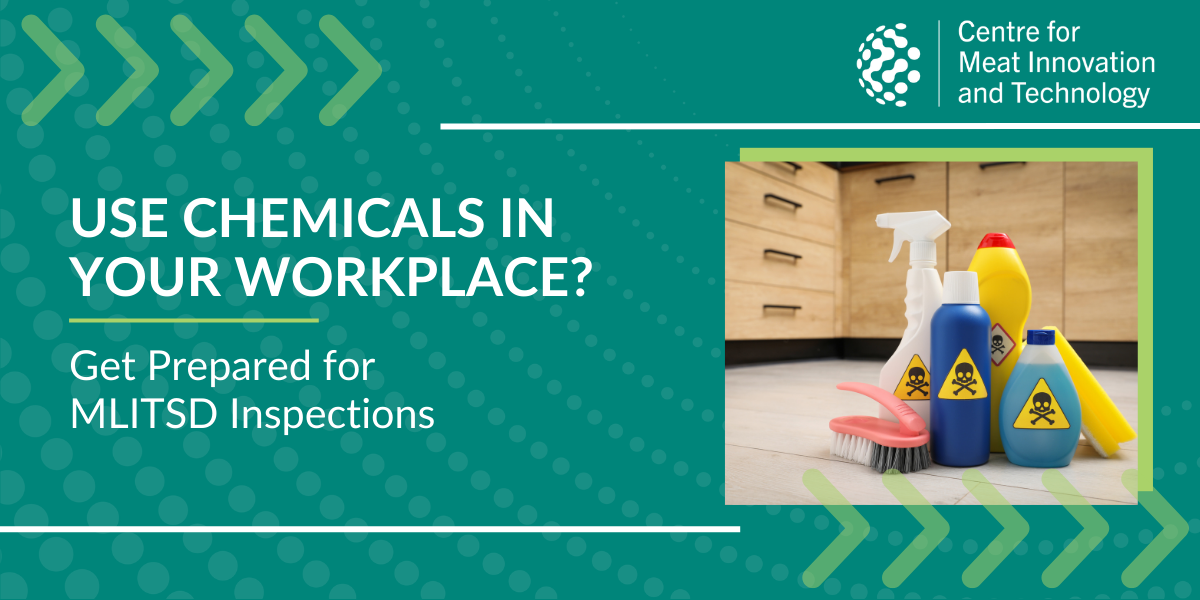
Use Chemicals in Your Workplace?
Get Prepared for MLITSD Inspections
From Workplace Safety & Prevention Services
“If a Ministry of Labour, Immigration, Training and Skills Development (MLITSD) inspector did not visit your workplace last year during the Worker Exposure to Chemical Agents or WHMIS Training campaigns, expect to get a knock on the door this year,” says Tova Larsen, Health and Safety Consultant with Workplace Safety & Prevention Services (WSPS).
The MLITSD has extended two occupational hygiene inspection campaigns until March 31, 2026. These inspections focus on worker exposure to hazardous chemicals and compliance with updated Workplace Hazardous Materials Information System (WHMIS) requirements under the amended Hazardous Products Regulations. “These inspections are already underway,” says Tova.
Why This Matters for the Meat and Poultry Industry
Occupational disease is the leading cause of worker deaths in Ontario. Between 2020 and 2024, 69 per cent of allowed fatality claims were due to occupational disease, often linked to chemical exposure. In the meat and poultry industry, hazardous chemicals are used daily for sanitation, refrigeration, pest control, and carcass treatment. “It would be difficult to find a workplace in Ontario that doesn’t have at least one chemical in the workplace,” says Tova. “They are everywhere, and they need to be handled safely.”
What will inspectors look for?
MLITSD inspections will focus on compliance with:
• Ontario Regulation 833: Control of Exposure to Biological or Chemical Agents
• Ontario Regulation 860: Workplace Hazardous Materials Information System (WHMIS)
Ontario Regulation 833: Control of Exposure to Biological or Chemical Agents
Under Ontario Regulation 833, every employer must take all measures reasonably necessary to protect workers from exposure to hazardous biological or chemical agents. Employers must control exposure to hazardous chemicals to ensure the occupational exposure limits (OELs) are not exceeded. “Regulation 833 contains approximately 725 Ontario-specific OELs to which employers must adhere,” says Tova.
In meat and poultry processing, this includes:
• Ammonia used in refrigeration systems is a toxic gas that can cause respiratory damage if leaked.
• Peracetic acid is a strong oxidizer that can irritate the eyes, skin, and lungs.
• Sodium hydroxide (caustic soda) used in cleaning can be corrosive and dangerous if inhaled or touched.
Tova also cautions against waiting for an inspector to arrive before addressing workers’ exposure. If a workplace cannot provide adequate evidence that exposure levels are below the legislated OELs, the inspector could order the workplace to conduct occupational hygiene chemical exposure testing of the air at the company’s cost to confirm that OELs are being met.
“For example, if the last time you measured chemical exposure in your workplace was 10 years ago, that may not be considered adequate evidence. The company could be required to consult an occupational hygienist to complete air testing,” says Tova. “So, it’s in the best interest of everyone to be proactive, test the exposure levels in your workplace, implement controls, provide training, and have all the documentation ready.” This is the best way to prevent occupational illness.
Ontario Regulation 860: Workplace Hazardous Materials Information System (WHMIS)
When it comes to Regulation 860, employers must ensure the safe handling, storage, and use of hazardous products in the workplace. Employers must ensure that all hazardous products:
• have proper WHMIS labels
• are accompanied by up-to-date Safety Data Sheets (SDSs)
• are used by workers who have received current WHMIS training
In meat and poultry facilities, this includes:
• disinfectants and sanitizers (e.g., chlorine-based products, quats)
• degreasers and solvents used in equipment maintenance
• pesticides and rodenticides used for pest control
With WHMIS transitioning to align with the 7th edition of the Globally Harmonized System (GHS), employers must update SDSs and retrain workers accordingly. “Once you have updated WHMIS labels and SDSs in your workplace, it triggers the need to update training,” says Tova.
How can employers prepare?
Start with the free MLITSD Occupational Hygiene Campaigns Toolkit from WSPS. Then, take these five steps:
1. Understand your legal requirements under Regulations 833 and 860.
2. Use the RACE model (Recognize, Assess, Control, Evaluate) to manage chemical hazards.
3. Get help if you have questions. Health and safety professionals and occupational hygienists can help your workplace develop a comprehensive hazardous chemical management program. “At WSPS, we have many free resources, including a list of Frequently Asked Questions about the inspections) (wsps.news/ChemicalFAQ), as well as qualified occupational hygienists who can answer your questions and provide other services,” says Tova.
4. Prepare documentation, including:
• Chemical inventory sheets
• Air testing reports
• SDSs
• Generic and job-specific WHMIS training records
• Medical surveillance records (if applicable)
5. Ensure a JHSC worker member is available to accompany the inspector and is familiar with your chemical safety program.
By proactively managing chemical hazards—especially those common in meat and poultry processing—employers can protect workers and ensure compliance during MLITSD inspections.